

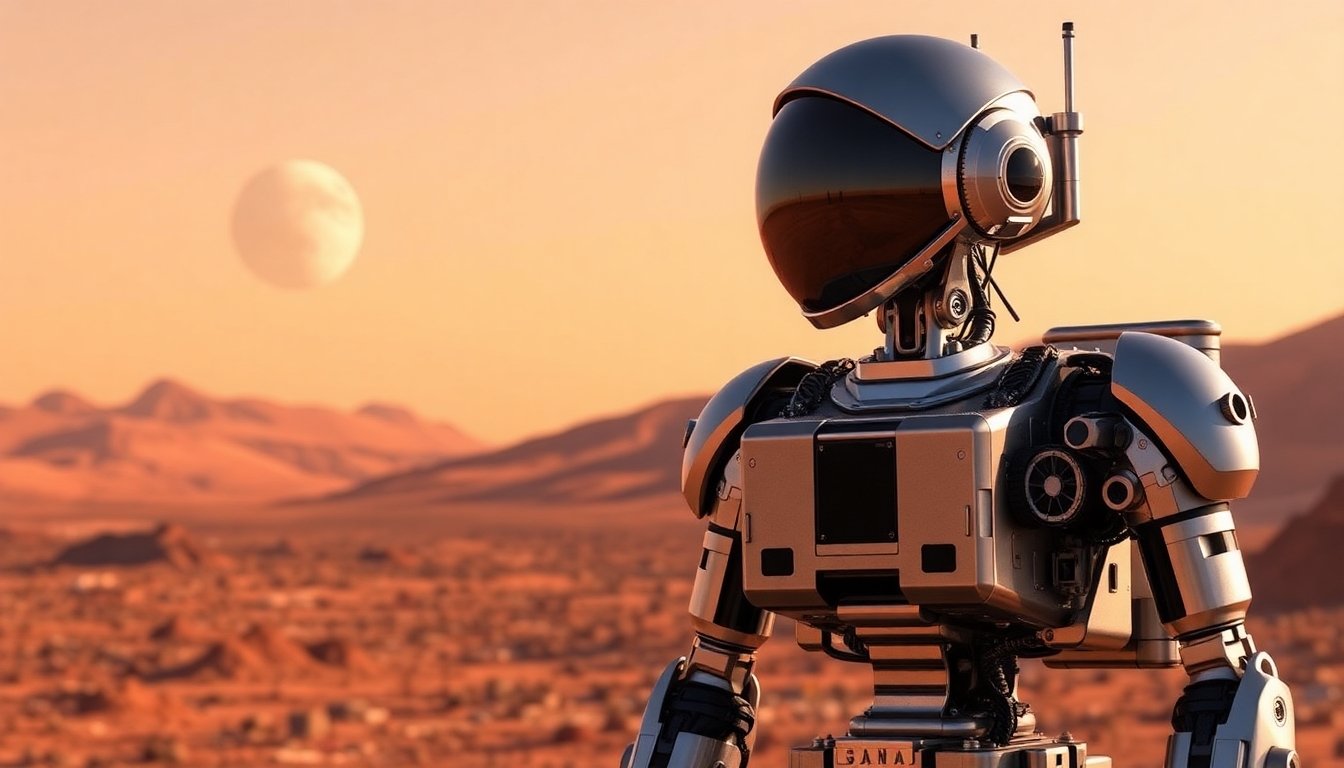
The colonization of Mars is no longer just a vision of science fiction. Advances in artificial intelligence, robotics, and quantum technology are bringing humanity closer to establishing sustainable settlements on the Red Planet. By 2035, AI-driven robots and quantum computing will play central roles in navigating extreme environments, building infrastructure, and ensuring the survival of human settlers, making Mars colonization safer, faster, and more efficient than ever before.
The Role of AI in Mars Exploration
Autonomous Robotics
AI-powered robots will perform high-risk tasks, including surface mapping, habitat construction, and resource extraction. These robots will operate autonomously, making real-time decisions in response to unpredictable Martian conditions.
AI in Navigation and Mission Planning
Machine learning algorithms will optimize flight paths, landing sequences, and rover navigation. AI will predict environmental hazards, weather patterns, and terrain challenges, enabling precise and safe operations.
Environmental Monitoring
AI sensors will continuously monitor radiation, atmospheric composition, and temperature, providing real-time data for human safety and infrastructure planning.
Robotics: Building the Martian Frontier
Construction Robots
Autonomous machines will assemble habitats, solar farms, and greenhouses using local Martian materials. 3D printing and AI-controlled robotic arms will reduce dependency on Earth-supplied resources.
Maintenance and Repair
Robots will handle maintenance of life support systems, energy grids, and communication networks, minimizing human exposure to harsh conditions.
Exploration and Resource Mining
AI-driven mining robots will extract water ice, minerals, and other essential resources. Advanced AI will analyze soil and rock samples, identifying sites suitable for agriculture, construction, and energy production.
Quantum Technology Transforming Mars Missions
Quantum Computing for Mission Optimization
Quantum computers will process vast amounts of data from satellites, rovers, and habitats to optimize logistics, energy consumption, and supply chain management on Mars.
Quantum Communication
Quantum-encrypted communication will enable secure, near-instant data transfer between Mars and Earth, overcoming latency challenges and protecting critical mission information.
Advanced Simulation and Modeling
Quantum simulations will model environmental conditions, potential hazards, and long-term colonization scenarios, allowing mission planners to make informed decisions and reduce risk.
AI-Driven Life Support and Sustainability
Predictive Resource Management
AI systems will monitor oxygen, water, food, and energy levels in habitats, predicting shortages and optimizing distribution to prevent crises.
Agriculture and Food Production
AI-controlled hydroponic and aeroponic farms will adapt to Martian conditions, regulating light, nutrients, and water to maximize crop yields.
Health Monitoring and Medical AI
AI-driven medical systems will monitor settlers’ health, predict potential illnesses caused by radiation or low gravity, and recommend preventive care or treatment.
Human-AI Collaboration on Mars
Decision-Making and Problem Solving
AI will provide real-time guidance to human explorers, analyzing data and simulating outcomes for critical decisions. Collaborative human-AI teams will tackle complex challenges faster and more safely.
Psychological Support
AI companions may provide mental health support for astronauts facing isolation, stress, and prolonged confinement on Mars. Virtual interactions and adaptive programs will mitigate psychological strain.
Education and Training
AI tutors will provide ongoing education and training to settlers, ensuring they can operate complex machinery, manage habitats, and respond to emergencies efficiently.
Benefits of AI and Quantum Technology in Mars Colonization
Increased Safety
AI robots handle hazardous tasks, reducing human risk during exploration and construction.
Efficiency and Cost Reduction
Autonomous systems and quantum optimization minimize resource consumption, logistics challenges, and operational costs.
Accelerated Colonization
AI and quantum tech enable faster construction, resource extraction, and habitat deployment, making Mars settlements feasible within decades.
Enhanced Research Capabilities
AI systems will analyze geological, atmospheric, and biological data, accelerating scientific discovery and supporting long-term colonization goals.
Challenges and Considerations
Technical and Engineering Limitations
Robust AI, robotics, and quantum systems must withstand Mars’ extreme temperatures, dust storms, radiation, and low gravity.
Ethical and Governance Issues
The use of autonomous robots and AI decision-making raises questions about accountability, safety, and mission oversight.
Human Adaptation
Settlers must adjust to working alongside AI systems and robots while maintaining physical and psychological health in a harsh environment.
Communication Delays and Reliability
Even with quantum communication, occasional latency and infrastructure failures could impact mission-critical operations, requiring redundant systems and autonomous AI decision-making.
The Future Outlook
By 2035, AI, robotics, and quantum technology will make Mars colonization a tangible reality. AI-driven autonomous systems will handle construction, maintenance, resource management, and exploration, while quantum computing and communication will optimize logistics and ensure secure operations. Human settlers will collaborate closely with AI companions and robotic assistants, creating resilient, self-sustaining Martian communities. This integration of advanced technologies promises a new era of interplanetary life, scientific discovery, and human expansion beyond Earth.
Conclusion
The colonization of Mars depends on the synergy between AI, robotics, and quantum technology. Together, these innovations will enable autonomous construction, real-time decision-making, resource optimization, and secure communication, transforming Mars from a distant dream into a functional human settlement. While challenges in engineering, ethics, and human adaptation remain, the future of space exploration is intelligent, automated, and increasingly achievable, heralding a new chapter in humanity’s quest to inhabit the stars.